Open Media Transport: A New Open Standard for Ultra-Low Latency IP Video


As IP-based video continues to replace traditional SDI infrastructures, broadcasters, system integrators, and Pro AV professionals are rethinking how video should be transported across networks. Today’s production environments demand ultra-low latency, high image fidelity, operational reliability, and long-term flexibility—without being locked into proprietary ecosystems.
This is exactly the challenge that Open Media Transport was created to solve.
What Is Open Media Transport?
Open Media Transport (OMT) is an open-source, royalty-free IP media transport protocol designed for professional video and audio distribution over standard Ethernet networks. Built with live production in mind, OMT focuses on delivering high-quality, low-latency media streams in controlled LAN environments, where predictability and performance matter most.
Unlike proprietary IP video solutions such as NDI, Open Media Transport is released under an open license, allowing manufacturers, developers, and integrators to deploy and scale systems without licensing fees, SDK restrictions, or vendor lock-in.
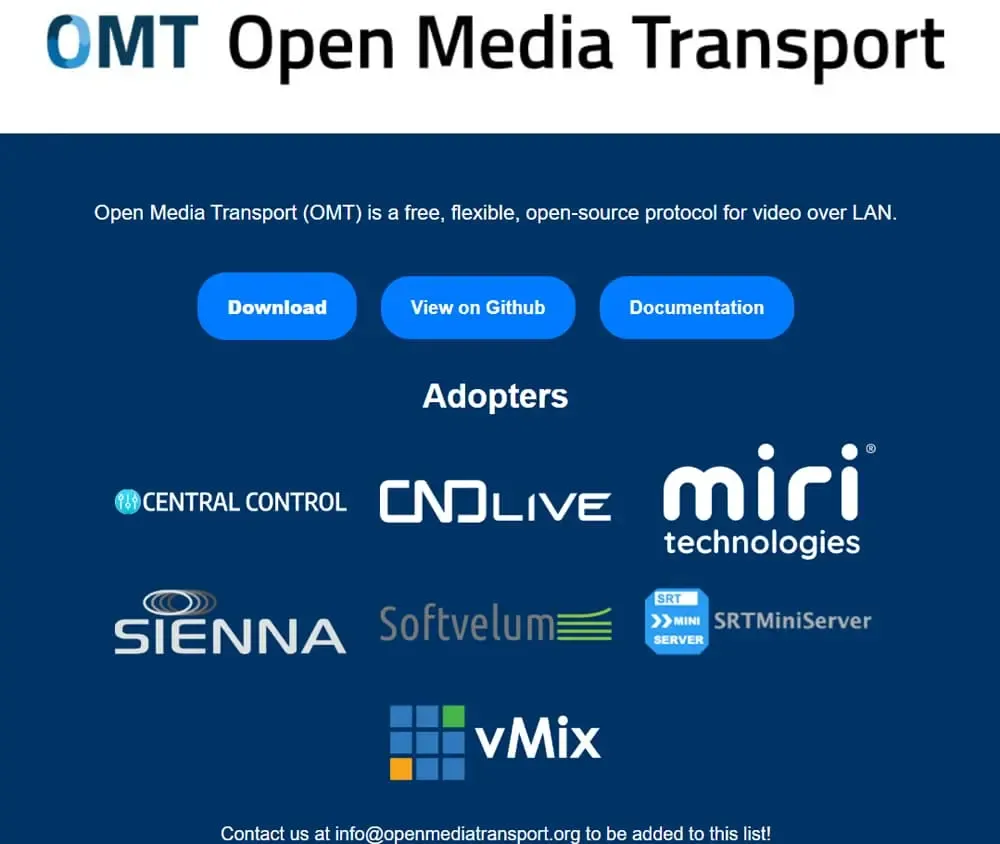
At its core, Open Media Transport is about openness, simplicity, and trust—giving professionals full visibility and control over how their media moves across the network.
Why the Industry Needs Open Media Transport
The transition to IP video has delivered enormous flexibility, but it has also introduced new challenges:
- Proprietary Constraints: Restrictive licensing models and dependency on vendor-specific SDKs.
- Performance Trade-offs: Constant compromises between image quality, latency, and available bandwidth.
- Unpredictable Networks: Inconsistent real-time performance in demanding, live production scenarios.
For OEM manufacturers and system integrators, these constraints create long-term technical and commercial risks. OMT addresses these concerns by delivering a fully open, transparent protocol optimized for deterministic, real-time performance.
Key Advantages of Open Media Transport
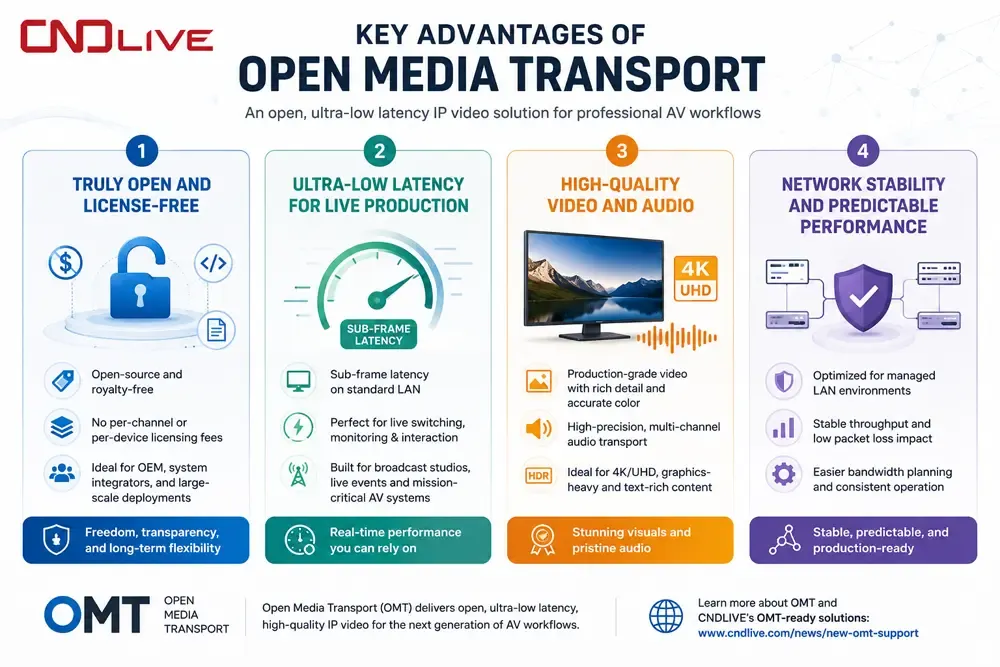
1. Truly Open and License-Free
One of the most compelling advantages of Open Media Transport is its open-source, royalty-free nature.
- Zero Licensing Fees: No per-channel or per-device costs.
- No Vendor Lock-in: No usage restrictions or closed SDK dependencies.
- OEM Friendly: Ideal for custom system designs, white-label products, and large-scale deployments.
2. Ultra-Low Latency for Live Production
Latency is a critical factor in live environments where even small delays can disrupt live switching, on-site monitoring, and interactive workflows.
- Engineered for sub-frame latency on standard LAN networks.
- Tailored for broadcast studios, live event production, and mission-critical AV control rooms.
- Prioritizes real-time performance over aggressive compression to ensure predictable delivery.
3. Production-Grade Video & High-Precision Audio
Image fidelity is never compromised. OMT preserves fine details, color accuracy, and sharp edges, which is essential for:
- 4K / UHD workflows and graphics-heavy broadcast content.
- Text-rich sources such as presentations and real-time data feeds.
- Multi-channel audio transport with high-precision synchronization for complex studio environments.
4. Managed Network Stability
Rather than attempting to adapt to unpredictable internet conditions, OMT is highly optimized for managed, professional LAN environments—the reality of most studios and fixed installations.
- Delivers stable throughput with minimal packet loss impact.
- Simplifies bandwidth planning for AV and IT teams.
- Results in fewer unexpected artifacts and greater operational confidence.
Protocol Comparison: OMT vs. Traditional IP Video
| Technical Aspect | Open Media Transport (OMT) | Traditional IP Video Protocols |
|---|---|---|
| Licensing | Fully open, 100% royalty-free | Proprietary, restricted, or per-device fees |
| Latency | Sub-frame latency on managed LAN | Varies heavily by codec and network mode |
| Image Quality | High, production-grade fidelity | Compression-dependent, prone to artifacts |
| Ecosystem Control | Fully transparent, community-driven | Vendor-dependent, closed-source roadmaps |
| OEM/Integration | Excellent flexibility, no SDK restrictions | Limited by restrictive SDK terms and compliance |
Turning Open Media Transport into Reality
While protocol innovation is essential, real-world workflows require professional, production-grade hardware support. CNDLive delivers this through two native OMT solutions.
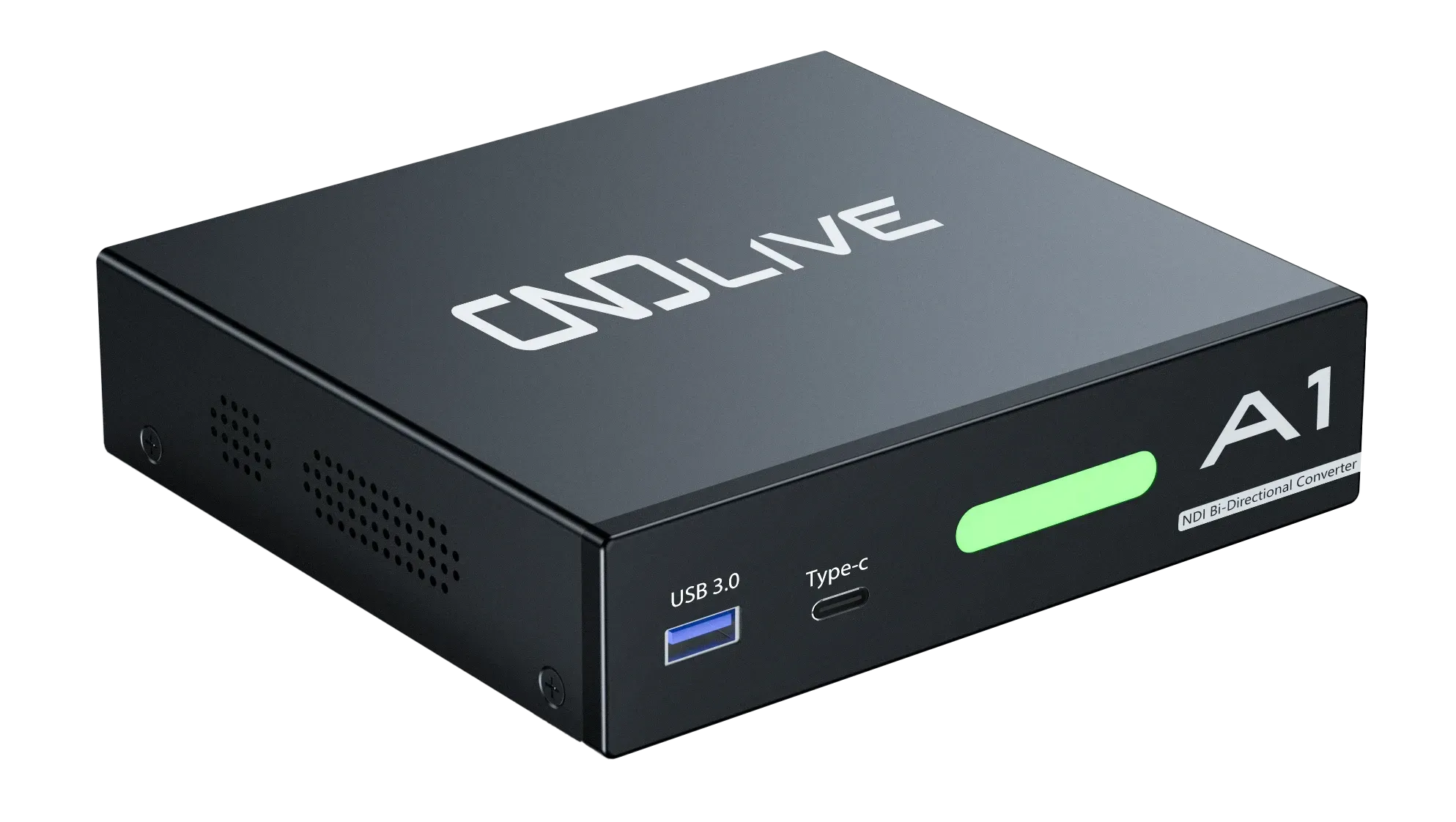
🛠 Solution 1: Product A1 (Broadcast-Grade Power)
Product A1 is engineered to bring OMT-based workflows directly into high-end production environments:
- Native OMT Integration: Built-in hardware decoding for seamless protocol support.
- 24/7 Reliability: Mission-critical stability designed for continuous broadcast operations.
- Seamless Deployment: Fits effortlessly into existing IP infrastructures.
📱 Solution 2: CNDLive NDI Go (Compact & Flexible)
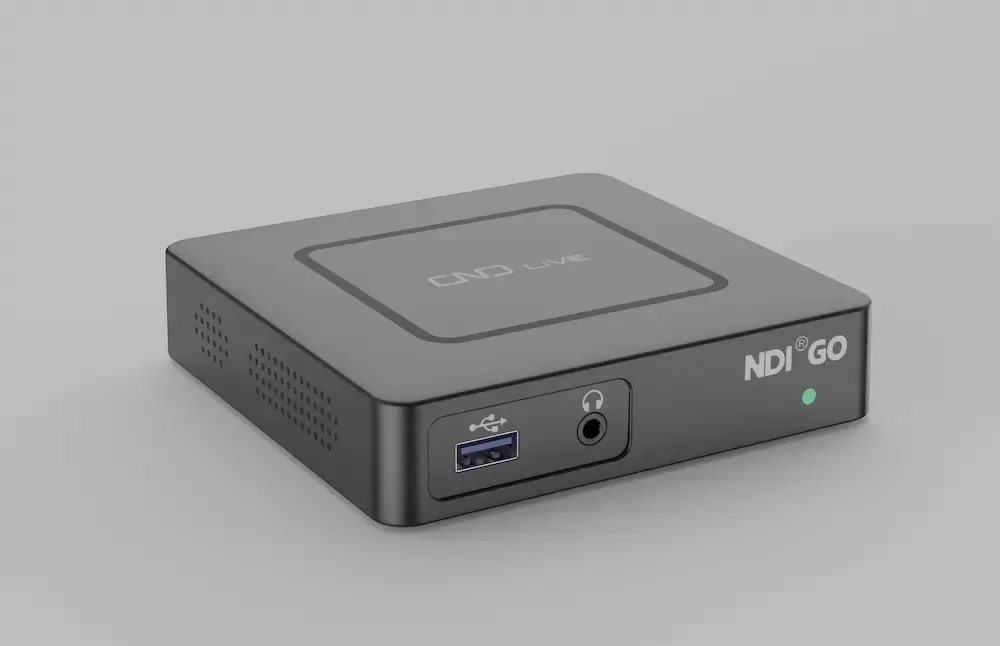
To bring OMT to more versatile and compact AV setups, the CNDLive NDI Go 4K HDMI Decoder offers native, hybrid protocol support. It functions as a cost-effective professional decoder built for 4K production and displays, running OMT and NDI side-by-side.
Key OMT-Ready Features of NDI Go:
- High Performance: Up to 4Kp60 decoding capability.
- Multi-Protocol: Native OMT combined with NDI, NDI|HX2, and NDI|HX3 compatibility.
- Simplified Cabling: Power over Ethernet (PoE) support with true plug-and-play setup.
- Pro AV Connectivity: 3.5mm analog audio line-out, PTZ control, and intercom support.
- Ultra-Compact Design: Perfect for equipment racks, mobile production flypacks, and fixed installations.
Why Choose OMT-Ready Hardware?
For organizations evaluating the future of their IP video infrastructure, choosing an OMT-ready decoder like Product A1 or NDI Go delivers undeniable strategic advantages:
- Fast, Low-Risk Deployment: Native protocol support means no experimental software setups.
- Eliminate Recurring Costs: Leverage OMT’s open-source design to slash licensing fees.
- Tailored Form Factors: Choose A1 for enterprise 24/7 rack reliability, or NDI Go for compact, PoE-driven flexibility.
- Future-Proof Alignment: Transition smoothly to open IP workflows while maintaining full compatibility with legacy NDI equipment.
The Future of Open IP Video
As the AV and broadcast industries continue to evolve, the demand for open, transparent, and high-performance IP video solutions will only increase. Open Media Transport represents a clear paradigm shift toward vendor independence and predictable, professional-grade performance.
When combined with purpose-built hardware like Product A1 and NDI Go, OMT empowers organizations to build next-generation IP video workflows—completely free of compromise.
Resources & Next Steps
- Explore Product A1: Learn how Product A1 enables modern IP video decoding workflows: https://www.cndlive.com/news/new-omt-support
- Explore CNDLive NDI Go: Check out technical specifications and ordering options: https://www.cndlive.com/products/ndi-to-hdmi-converter
- OMT Open Source Project: Visit the official repository on GitHub: https://github.com/openmediatransport