Encrypted Video Chat: How to Secure Real-Time Professional Video Communication
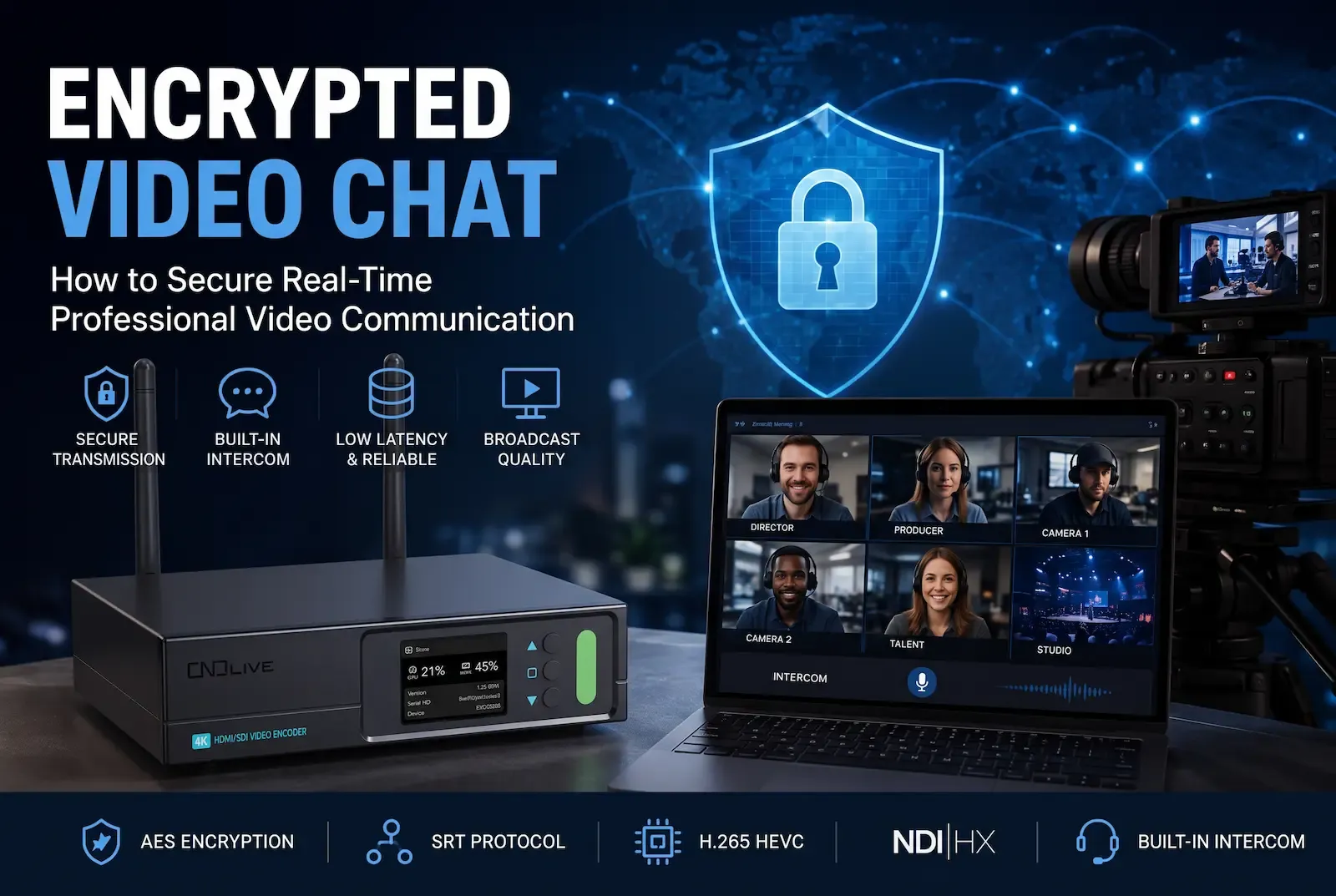

AWhether you’re broadcasting a live sporting event, coordinating a remote production team, conducting a confidential corporate meeting, or supporting emergency operations, secure communication has become a fundamental requirement. In today’s connected world, video is no longer limited to casual conversations between friends—it carries business strategies, financial information, medical consultations, public safety operations, and live broadcast content that often cannot be exposed to unauthorized viewers.
This growing demand has made encrypted video chat far more than a convenience feature. It has become a critical technology for organizations that rely on real-time communication without compromising privacy or operational security.
Unlike traditional messaging apps, professional video workflows often involve high-resolution camera feeds, multiple participants, dedicated production equipment, and public Internet transmission. These environments require more than simply connecting a webcam to a video conferencing application. They demand reliable encryption, ultra-low latency, stable transmission, and seamless communication between operators.
Imagine a television director giving instructions to camera operators during a live concert. Consider a news crew sending footage from a disaster area back to the studio. Or think about a hospital connecting specialists across different cities for an urgent consultation. In every case, video quality is important—but so is ensuring that the conversation cannot be intercepted or manipulated while traveling across the network.
This is where encrypted video communication technologies play a vital role.
Modern professional workflows combine secure transmission protocols, advanced video codecs, and real-time collaboration tools to create communication systems that are both efficient and protected. Whether the video is transmitted over a private network or across the public Internet, encryption helps ensure that only authorized users can access the content.
In this guide, we’ll explain what encrypted video chat is, how it works, why encryption matters for professional environments, and which technologies are commonly used to protect live video streams. We’ll also explore why encryption alone isn’t enough for mission-critical productions and how modern broadcast workflows combine secure transport with real-time team communication.
What Is Encrypted Video Chat?
At its simplest, encrypted video chat refers to any video communication system that protects transmitted data using cryptographic techniques. Instead of sending video and audio as plain data across the Internet, encryption transforms the information into unreadable ciphertext that can only be decoded by authorized participants possessing the correct encryption keys.
Without encryption, anyone capable of intercepting network traffic could potentially view sensitive conversations, capture confidential video, or even manipulate transmitted data. Encryption prevents this by ensuring that intercepted traffic remains meaningless without the proper decryption credentials.
An encrypted video communication session typically protects several different types of information:
- Live video streams
- Audio conversations
- User authentication
- Session signaling
- Device identification
- Control commands between systems
Together, these layers help safeguard both the content being shared and the communication process itself.
How Encryption Works
Although the mathematics behind encryption can be highly complex, the basic concept is relatively straightforward.
When a camera captures video, the device first compresses the footage using a video codec such as H.264 or H.265. Before the compressed data is transmitted over the network, an encryption algorithm converts it into encrypted packets using a secret key.
Those encrypted packets travel through routers, switches, ISPs, and sometimes even public cloud infrastructure. Anyone intercepting the traffic would only see encrypted data—not the actual video.
Once the packets arrive at the receiving device, the matching decryption key restores the original video in real time, allowing viewers to watch the stream without noticeable delay.
The process happens continuously throughout the session, protecting every frame of video and every second of audio.
Encryption Is More Than Privacy
Many people associate encryption solely with privacy, but its benefits extend much further.
A properly encrypted communication system helps protect against:
- Unauthorized viewing of confidential video
- Data interception during Internet transmission
- Content tampering or modification
- Identity spoofing
- Session hijacking
- Industrial espionage
- Information leakage during remote collaboration
For organizations handling sensitive information, encryption has become a fundamental component of cybersecurity rather than simply an optional feature.
Consumer Video Chat vs. Professional Video Communication
When most people hear the phrase “video chat,” they think of applications like Zoom, Microsoft Teams, Google Meet, or FaceTime.
These platforms work exceptionally well for everyday meetings and online collaboration. They provide built-in encryption, user-friendly interfaces, and cross-platform compatibility for millions of users worldwide.
However, professional video production environments often have very different requirements.
Instead of webcam video, they may use:
- Broadcast cameras
- PTZ cameras
- SDI or HDMI sources
- NDI video networks
- Multiple synchronized video feeds
- Hardware encoders
- Dedicated decoders
- Production switchers
Rather than simply connecting two people, these systems may need to support entire production crews operating across multiple locations while maintaining broadcast-quality image fidelity and extremely low latency.
In these scenarios, encryption becomes only one piece of a much larger communication ecosystem.
Why Encryption Matters for Professional Video Workflows
For many organizations, video is no longer just another communication tool—it has become a critical business asset. A leaked board meeting, an intercepted news feed, or an exposed emergency response operation can lead to financial losses, reputational damage, or even public safety risks.
As professional teams increasingly rely on IP-based workflows and cloud connectivity, protecting video communications has become just as important as protecting emails or financial records.
Let’s examine several industries where encrypted video chat plays a crucial role.
Remote Production
Remote production has transformed the broadcast industry.
Instead of transporting entire production crews to every event, broadcasters can now place cameras on location while directors, replay operators, graphics teams, and producers work hundreds or even thousands of miles away.
Camera feeds travel over IP networks to centralized production facilities, dramatically reducing travel costs and improving operational flexibility.
However, transmitting valuable live footage over public Internet connections introduces new security challenges.
Without encryption, unauthorized users could potentially monitor camera feeds, intercept communications, or access unreleased broadcast content before it reaches viewers.
Secure transmission protocols help protect these video streams while maintaining the low latency required for live television production.
Corporate Communications
Large enterprises routinely conduct confidential meetings involving executive leadership, legal teams, financial departments, and international partners.
These conversations often include:
- Product development plans
- Financial forecasts
- Acquisition discussions
- Intellectual property
- Customer information
- Internal strategy
A security breach could expose highly sensitive business information with significant commercial consequences.
Encrypted video communication helps ensure that confidential meetings remain accessible only to authorized participants, even when employees connect remotely from different offices or countries.
Healthcare and Telemedicine
Healthcare organizations increasingly depend on secure video consultations to improve patient care.
Doctors can collaborate with specialists remotely, monitor patients through telehealth platforms, and provide medical advice without requiring physical travel.
Because these consultations frequently involve personal health information, strong encryption is essential for protecting patient privacy and meeting healthcare data protection regulations.
Security is particularly important when consultations occur across multiple hospitals or through cloud-based communication platforms.
Public Safety and Emergency Response
Police departments, fire services, emergency medical teams, and disaster response organizations often coordinate operations using live video feeds.
These communications may include:
- Incident command
- Drone footage
- Body camera streams
- Tactical planning
- Infrastructure monitoring
If intercepted, such information could compromise ongoing operations or endanger personnel.
Encrypted video transmission helps maintain operational security while enabling real-time collaboration between field teams and command centers.
Education and Government
Educational institutions and government agencies also rely on secure video communication for remote teaching, internal meetings, public administration, and sensitive policy discussions.
While not every conversation contains classified information, maintaining the confidentiality and integrity of communications remains an important responsibility.
Encryption provides an additional layer of trust that supports secure digital collaboration.
Regulatory Compliance
Beyond protecting privacy, many industries are legally required to safeguard digital communications.
Organizations may need to comply with regulations concerning:
- Data protection
- Privacy
- Financial reporting
- Healthcare records
- Government security standards
Although specific requirements vary between countries and industries, encrypted communication often forms part of a broader compliance strategy designed to reduce cybersecurity risks.
Common Encryption Technologies Used in Video Communication
Different video communication systems use different encryption methods depending on their intended applications. Consumer video conferencing platforms, web browsers, enterprise communication tools, and professional broadcast systems each prioritize different combinations of security, latency, scalability, and compatibility.
Understanding these technologies can help organizations choose the right solution for their workflows.
| Technology | Primary Purpose | Typical Applications |
|---|---|---|
| TLS (Transport Layer Security) | Protects signaling and control traffic | Video conferencing, secure websites, messaging |
| DTLS-SRTP | Encrypts browser-based media streams | WebRTC applications, browser video chat |
| AES (Advanced Encryption Standard) | Encrypts video and audio payloads | Professional AV, enterprise systems, broadcast |
| SRT (Secure Reliable Transport) | Secure low-latency video transport | Live broadcasting, remote production, contribution links |
| VPN (Virtual Private Network) | Creates encrypted network tunnels | Enterprise remote access, private production networks |
Let’s take a closer look at the most common technologies.
TLS: Securing Communication Before Video Begins
Transport Layer Security (TLS) is one of the most widely used security protocols on the Internet. It protects the communication that occurs before the actual video stream starts, such as user authentication, device verification, and session setup.
When you log into a secure website or join an online meeting, TLS helps verify the identity of the server and encrypts the initial exchange of information. This prevents attackers from impersonating trusted services or stealing login credentials during the connection process.
While TLS is essential for establishing secure sessions, it is typically not responsible for encrypting the live video itself.
DTLS-SRTP: Browser-Based Secure Video
Many browser-based communication platforms use a combination of Datagram Transport Layer Security (DTLS) and Secure Real-time Transport Protocol (SRTP).
DTLS securely exchanges encryption keys between participants, while SRTP encrypts the audio and video streams transmitted during the call.
This combination forms the security foundation of many WebRTC-based applications, making it possible to deliver encrypted video directly within modern web browsers without requiring additional software installations.
Because of its compatibility and ease of deployment, DTLS-SRTP has become a standard choice for online meetings, customer support systems, and browser-based collaboration tools.
AES: The Industry Standard for Media Encryption
At the heart of many secure video systems is the Advanced Encryption Standard (AES).
AES is a symmetric encryption algorithm trusted by governments, enterprises, financial institutions, and broadcasters around the world. It is valued for its strong security, efficiency, and broad hardware support.
Professional video solutions commonly use AES-128 or AES-256, depending on the desired balance between performance and security.
Rather than being a complete transport protocol on its own, AES is often integrated into other technologies to encrypt the actual media payload. For example, SRT can use AES encryption to protect video streams while maintaining reliable delivery over unpredictable networks.
This combination of proven encryption and real-time performance has made AES the foundation of many modern professional video communication systems.
SRT: Secure Reliable Transport for Professional Video
While protocols like TLS and DTLS-SRTP are widely used in conferencing and browser-based communication, professional broadcasters and live production teams often require something more robust. Their workflows involve transmitting high-quality video over unpredictable public networks while maintaining low latency and uninterrupted communication.
This is where Secure Reliable Transport (SRT) has become one of the industry’s preferred technologies.
Originally developed by Haivision and later released as an open-source protocol through the SRT Alliance, SRT was specifically designed to transport professional-quality video across unreliable IP networks. Today, it is supported by hundreds of hardware and software vendors throughout the broadcast industry.
Unlike traditional streaming protocols that prioritize either speed or reliability, SRT is designed to deliver both.
Its key advantages include:
- AES-128 and AES-256 encryption to protect video streams from unauthorized access.
- Automatic packet recovery to retransmit lost packets without requiring manual intervention.
- Low-latency transmission that keeps delays to a minimum, even over long-distance Internet connections.
- Network adaptation that adjusts to changing bandwidth and fluctuating network conditions.
These capabilities make SRT especially valuable for applications such as:
- Live sports broadcasting
- News contribution
- Remote production
- Corporate live events
- Government communications
- Educational broadcasting
- Houses of worship
- Hybrid conferences
Because SRT combines security with reliability, many organizations consider it one of the best options for transporting professional video over the public Internet without sacrificing quality.
Challenges Beyond Encryption
Encryption is essential—but it is only one part of successful professional video communication.
A perfectly encrypted stream is of little value if it arrives several seconds late, freezes during critical moments, or leaves production teams unable to coordinate effectively.
Professional video workflows face a number of challenges that encryption alone cannot solve.
Network Instability
Unlike private fiber networks, public Internet connections are constantly changing.
Bandwidth may fluctuate due to:
- Network congestion
- Wi-Fi interference
- Mobile network transitions
- ISP routing changes
- Long-distance transmission
These issues can introduce packet loss, jitter, and inconsistent latency, all of which negatively affect live video quality.
Modern transport protocols such as SRT help mitigate these problems through intelligent packet recovery and adaptive buffering.
Latency Matters
For casual video meetings, a delay of one or two seconds is usually acceptable.
For live production, however, even small delays can create significant operational problems.
Imagine a director giving instructions to a camera operator several seconds after the action has already occurred. By the time the operator reacts, the moment is gone.
Low latency is critical for:
- Sports broadcasting
- Live concerts
- Worship services
- Remote interviews
- Auction events
- Interactive live shows
Choosing the right transport technology is therefore just as important as encrypting the communication itself.
Video Quality Must Remain Consistent
Professional productions often use:
- Full HD
- 4K
- HDR
- High frame rates
- Broadcast-quality audio
Maintaining this quality over the Internet requires efficient compression and reliable transmission.
Modern codecs such as H.265 (HEVC) significantly reduce bandwidth requirements while preserving image quality, making them ideal companions to encrypted transport protocols like SRT.
Team Communication Is Just as Important
One challenge that many newcomers overlook is that live production is rarely a one-person operation.
A successful production typically involves multiple roles working together simultaneously:
- Director
- Camera operators
- Audio engineer
- Graphics operator
- Replay technician
- Streaming engineer
- Stage manager
These people must communicate continuously while monitoring live video.
Simply watching an encrypted stream is not enough—they also need instant voice communication.
This is where intercom systems become indispensable.
The Role of Intercom in Professional Encrypted Video Chat
When people hear the phrase video chat, they often imagine two people talking face-to-face through a conferencing application.
Professional broadcasting works very differently.
Instead of casual conversations, production teams rely on real-time operational communication, often called talkback, IFB (Interruptible Foldback), or intercom.
An intercom system allows team members to communicate instantly while simultaneously monitoring live video.
For example:
- A director instructs camera operators where to frame the next shot.
- A producer counts down to a live interview.
- An engineer reports technical issues.
- A stage manager coordinates performers.
- A replay operator confirms that highlights are ready.
All of this happens in real time—often within fractions of a second.
Without reliable intercom, even a perfectly encrypted video stream can become difficult to manage.
Imagine trying to produce a live football match if every instruction had to be sent by text message. Communication would quickly become chaotic.
That’s why professional productions treat intercom as an integral part of the workflow rather than an optional accessory.
When combined with secure video transport, intercom enables geographically distributed teams to collaborate almost as if they were working in the same control room.
A Practical Solution for Secure Remote Production
Organizations looking to build secure video communication systems typically need more than software alone.
They often require dedicated hardware capable of delivering:
- Broadcast-quality video encoding
- Secure Internet transmission
- Low-latency performance
- Flexible workflow integration
- Reliable long-duration operation
- Real-time team communication
One example is the CNDLive C6 H.265 NDI SRT Encoder.
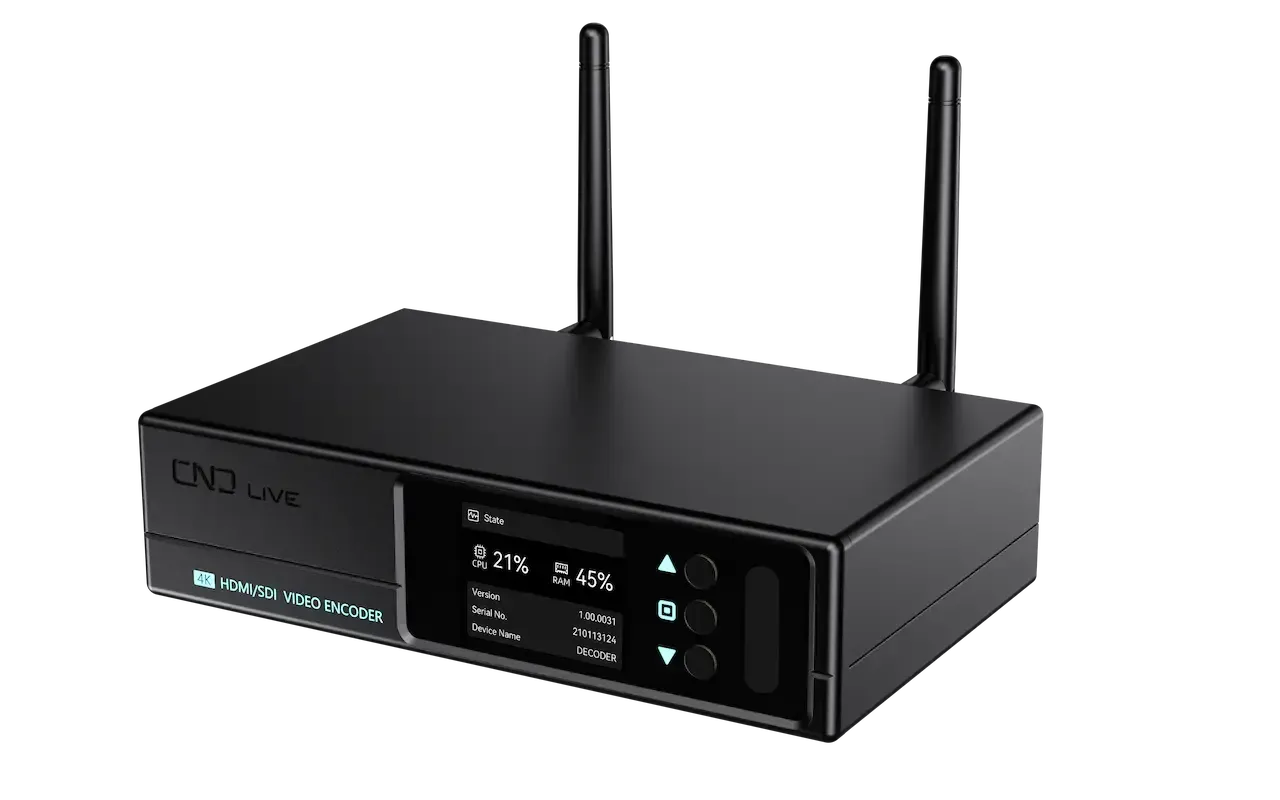
Designed for professional IP video workflows, the C6 combines multiple technologies into a compact hardware encoder suitable for live production, remote contribution, and enterprise streaming applications.
Key capabilities include:
Secure SRT Transmission
The C6 supports SRT for encrypted video transport, helping protect live streams transmitted across public or private IP networks.
By combining secure encryption with reliable packet recovery, SRT allows production teams to maintain stable video even under challenging network conditions.
High-Efficiency H.265 Encoding
Using H.265 (HEVC) compression, the encoder delivers excellent image quality while significantly reducing bandwidth requirements compared to older compression standards.
This is especially valuable when transmitting over limited-bandwidth Internet connections.
NDI Workflow Integration
For organizations already using NDI, the C6 integrates smoothly into modern IP-based production environments.
This simplifies video distribution between cameras, switchers, production software, and monitoring systems without requiring extensive SDI infrastructure.
Built-in Intercom
One of the most valuable features for remote production is the integrated intercom capability.
Rather than relying on separate communication equipment, production teams can coordinate directly through the encoder, improving workflow efficiency and reducing system complexity.
Directors, camera operators, and technical staff can stay connected while monitoring encrypted live video, creating a more seamless production experience.
Designed for Professional Applications
Typical deployment scenarios include:
- Live event production
- Corporate broadcasting
- Remote interviews
- Sports streaming
- Houses of worship
- Educational campuses
- Government communications
- Emergency command centers
In these environments, secure transmission, reliable performance, and effective team coordination are equally important.
Best Practices for Secure Video Communication
Regardless of which platform or hardware you choose, following established security practices can significantly improve the safety and reliability of your video workflows.
Use Encrypted Transport Protocols
Whenever possible, choose protocols that support strong encryption, such as SRT or secure WebRTC implementations.
Avoid transmitting sensitive video over unencrypted protocols.
Protect Access Credentials
Use strong passwords, unique user accounts, and multi-factor authentication whenever available.
Limiting system access reduces the risk of unauthorized viewing.
Keep Firmware Updated
Hardware encoders, decoders, cameras, and networking equipment should be updated regularly.
Firmware updates often include important security patches and performance improvements.
Separate Critical Production Networks
For high-value productions, consider separating production traffic from general office or guest networks.
Network segmentation reduces potential attack surfaces and improves overall reliability.
Test Before Going Live
Always perform end-to-end testing before important events.
Verify:
- Video quality
- Audio synchronization
- Encryption settings
- Network stability
- Intercom functionality
- Backup paths
A few minutes of preparation can prevent major problems during live broadcasts.
Frequently Asked Questions
Is encrypted video chat completely secure?
No security technology can guarantee absolute protection.
However, modern encryption algorithms combined with proper authentication, secure network practices, and regular software updates provide an extremely high level of protection against unauthorized access.
Does Zoom use encryption?
Yes.
Zoom supports encrypted communications and offers end-to-end encryption for eligible meetings.
However, professional broadcast environments often require additional capabilities such as dedicated hardware encoding, ultra-low latency, broadcast-quality video, SRT transport, and integrated intercom systems that extend beyond traditional video conferencing.
What is the difference between SRT and WebRTC?
Both technologies support secure real-time communication, but they are optimized for different use cases.
WebRTC is primarily designed for browser-based interactive communication.
SRT is optimized for transporting professional-quality video across unreliable networks while maintaining low latency, high reliability, and broadcast-grade performance.
Why is intercom important during live production?
Intercom enables production teams to communicate instantly while monitoring live video.
Without reliable voice coordination, directors, camera operators, engineers, and other crew members cannot respond quickly to changing production requirements.
For professional workflows, intercom is often just as important as the video itself.
Can hardware encoders support encrypted video transmission?
Yes.
Many professional hardware encoders support secure transmission protocols such as SRT with AES encryption.
Devices that also integrate features like H.265 encoding, NDI compatibility, and built-in intercom can further simplify remote production workflows while maintaining high levels of security and operational efficiency.
Conclusion
As organizations continue adopting IP-based production and remote collaboration, encrypted video chat has evolved far beyond consumer video conferencing. Today’s professional workflows demand secure transmission, broadcast-quality video, low latency, and seamless coordination among distributed teams.
Encryption remains the foundation of secure communication, protecting valuable video and audio from unauthorized access. But in mission-critical environments, security alone is not enough. Reliable transport, efficient compression, resilient network performance, and real-time crew communication all contribute to a successful production.
Technologies such as AES encryption, SRT, H.265, and NDI have become key building blocks for modern professional video systems. When paired with integrated intercom capabilities, they enable teams to collaborate confidently across cities, countries, or even continents without sacrificing performance or security.
Whether you’re producing a live sporting event, broadcasting a corporate conference, coordinating emergency response operations, or building a next-generation AV workflow, investing in secure and reliable communication infrastructure is no longer optional—it’s an essential part of delivering professional results.
By combining encrypted video transport with efficient encoding and built-in intercom, solutions like the CNDLive C6 H.265 NDI SRT Encoder provide a practical foundation for secure, low-latency, and highly collaborative video communication in today’s connected world.