The Event Organizer’s Guide to High-Definition, Low-Latency Live Concert Video Production
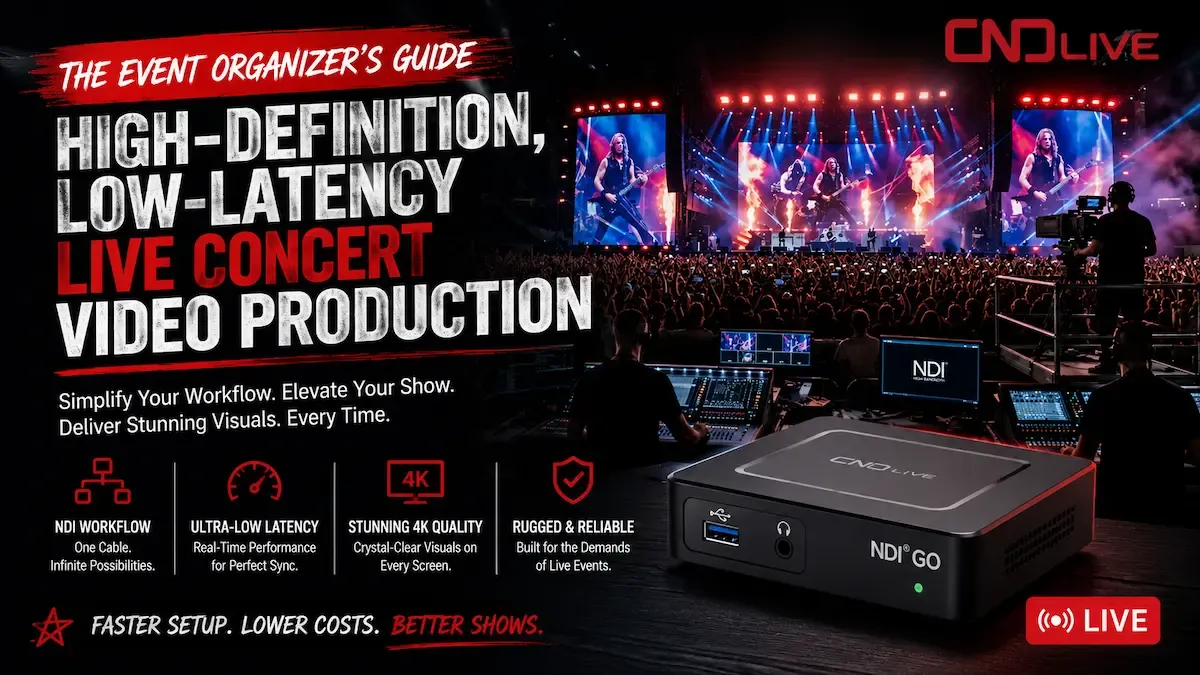

The modern concert experience is as much visual as it is auditory. Today’s audiences do not just expect great sound; they demand immersive, high-definition visual spectacles. From towering main LED walls and massive Image Magnification (IMAG) side-screens to dynamic stage projection mapping, video production has become a core pillars of live entertainment.
For concert organizers and event producers, executing this flawless visual experience involves managing a high-stakes ecosystem where multiple moving camera angles, media servers, and director cuts must align with absolute, zero-latency synchronicity.
However, behind the dazzling content on screen lies a massive logistical headache: video signal routing. For decades, production teams have battled with rigid, heavy, and expensive infrastructure to move video from cameras to front-of-house (FOH) and ultimately to the screens.
As concert venues grow larger and production designs become more complex, traditional cabling methods are rapidly hitting a wall. To stay competitive, reduce overhead, and deliver the pristine visuals modern audiences expect, event organizers must look to the future of signal routing: IP-based video workflows.
The Nightmare of Traditional Concert Cabling
To appreciate where live concert video production is going, we must first look at the immense physical and financial toll of where it has been. Traditional video routing relies heavily on point-to-point baseband cabling, primarily HDMI and SDI (Serial Digital Interface). While these standards have served the industry well for years, they introduce severe operational bottlenecks when scaled to the size of a modern stadium or festival arena.
The first major hurdle is distance limitation. Standard HDMI cables lose signal integrity after just a few meters, making them entirely useless for routing camera feeds across a venue. While copper SDI cables fare better, they still suffer from drastic signal degradation over long runs.
For large-scale stadium tours, production teams are forced to deploy expensive, fragile fiber-optic conversion kits to bridge the gap between the stage, the director’s desk, and remote cameras. Every conversion point introduces a new potential failure mechanism into the broadcast chain.
Furthermore, the labor and time required for setup and tear-down (“strike time”) represent a massive chunk of an organizer’s budget. Production crews spend countless hours running thick, heavy copper cable snakes through overhead trusses, under heavy rubber floor ramps, and across crowded backstage corridors. This heavy infrastructure significantly adds to the shipping weight of tour trunks, driving up freight and logistics costs.
Perhaps the most frustrating limitation of traditional cabling is its single-purpose architecture. In a legacy setup, one physical cable equals one video signal.
If a live director suddenly decides they want to route a different camera feed to a backstage VIP monitor or change the destination of an AUX cut on the fly, a technician has to physically unplug and re-route cables, or a completely new line must be laid. This lack of flexibility leaves no room for creative improvisation or rapid troubleshooting during a live show.
How NDI Transforms Live Concert Video Production
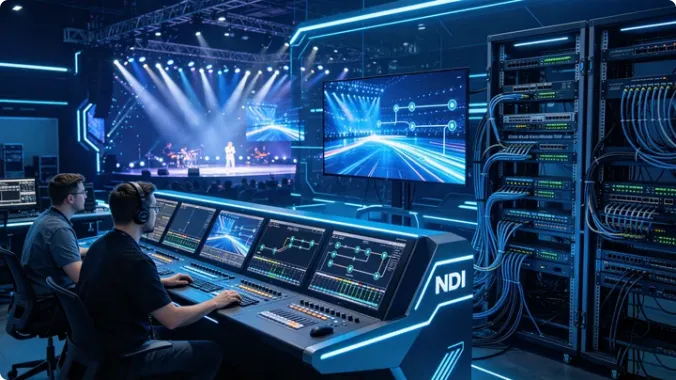
Network Device Interface, or NDI, is completely rewriting the rules of live event infrastructure by replacing specialized, rigid video cables with standard, flexible IP networks. Developed by NewTek, NDI allows high-definition and 4K video, multi-channel audio, control data, and power to be transmitted bidirectionally over a standard gigabit Ethernet local area network (LAN). In a concert environment, this means instead of running proprietary video cables everywhere, the production team establishes a robust network backbone using standard Cat6 or fiber network switches.
The operational advantages this shift brings to concert organizers are profound. First and foremost is the concept of “one cable to rule them all.” A single, lightweight Cat6 Ethernet cable can simultaneously carry a pristine 4K video stream, Power over Ethernet (PoE) to run the device, bidirectional intercom voice communication for the crew, and tally light signals for the camera operators. Instead of managing a tangled mess of four separate cables per camera or monitor, a single network line does it all.
This network-centric approach unlocks infinite scalability. Because every video source and every display destination lives on the same local network, they can all “see” one another instantly. Through a simple software interface, a video engineer can route any camera feed to any screen in the venue with a single mouse click.
If the director wants to instantly clone the main stage feed onto twenty different concession-area displays or backstage production monitors, it can be done instantly without running a single new foot of wire.
From a financial perspective, transitioning to an NDI-based workflow yields immediate ROI. It drastically slashes the physical weight of video equipment trunks, resulting in lower shipping and fuel costs for touring productions.
Because network cables are infinitely easier and faster to deploy than heavy SDI snakes, load-in and load-out times are cut by hours. This means reduced union labor costs at venues and faster turnaround times when traveling between tour stops.
The “Last Mile” Challenge: Why Software Alone Isn’t Enough
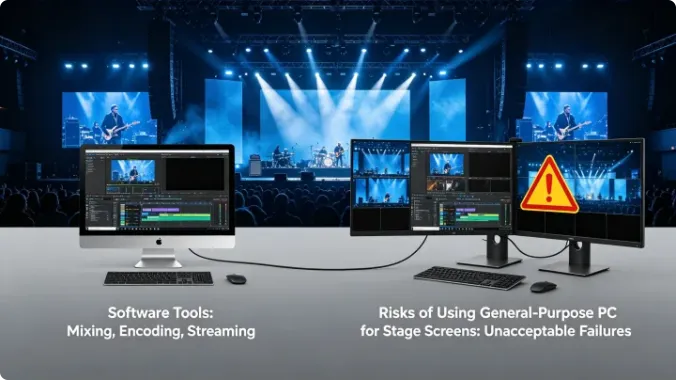
As production teams begin to adopt NDI, many attempt to manage the entire workflow using software-based switching and decoding tools like OBS Studio, vMix, or proprietary software players running on standard computers. While these software tools are incredibly powerful for mixing, encoding, and streaming a show, relying entirely on general-purpose PCs to drive physical screens on a live concert stage introduces massive, unacceptable risks.
The most glaring issue is the inherent instability of consumer and commercial operating systems. A computer running Windows or macOS is constantly executing hundreds of background tasks, from automatic system updates and security scans to driver verifications.
In a live concert environment where a single second of black screen is a catastrophic production failure, you cannot risk a software crash, a blue screen, or an accidental mouse cursor drifting across a multi-million-dollar main LED video wall.
Additionally, decoding multiple high-bandwidth, high-frame-rate NDI streams (especially Full NDI) demands immense computational horsepower. If a front-of-house computer is tasked with switching the live show, encoding the stream for the internet, and simultaneously decoding multiple 4K return feeds for physical screens, the CPU and GPU can easily bottleneck. This overhead causes dropped frames, stuttering video, and software lag.
Furthermore, general-purpose computers introduce significant rendering latency through their operating system’s graphics pipeline. For concert IMAG screens, timing is critical. If the video displayed on the giant screens beside the stage lags even a fraction of a second behind the performer’s actual movements, the human brain instantly notices the lips out of sync with the PA system audio, completely breaking the immersion for the audience.
To bridge this “last mile” safely and efficiently, professional live concert video production requires dedicated, purpose-built hardware decoders. These standalone devices sit at the physical destination, taking the pure network stream and converting it directly into an uncompressed, ultra-low-latency hardware signal that video walls and projectors can natively accept.
Product Spotlight: CNDLive NDI Go – The Ultimate Concert Decoder
To overcome the challenges of the last mile and fully realize the benefits of an IP-based workflow, production teams require ruggedized, broadcast-grade endpoints. The CNDLive NDI Go is a premium hardware NDI-to-HDMI decoder engineered precisely for the grueling demands of the live event environment. Rather than relying on fragile computer architecture, the NDI Go utilizes an optimized embedded system designed to perform one critical task with flawless reliability: decoding high-bandwidth network video streams into pristine physical signals.
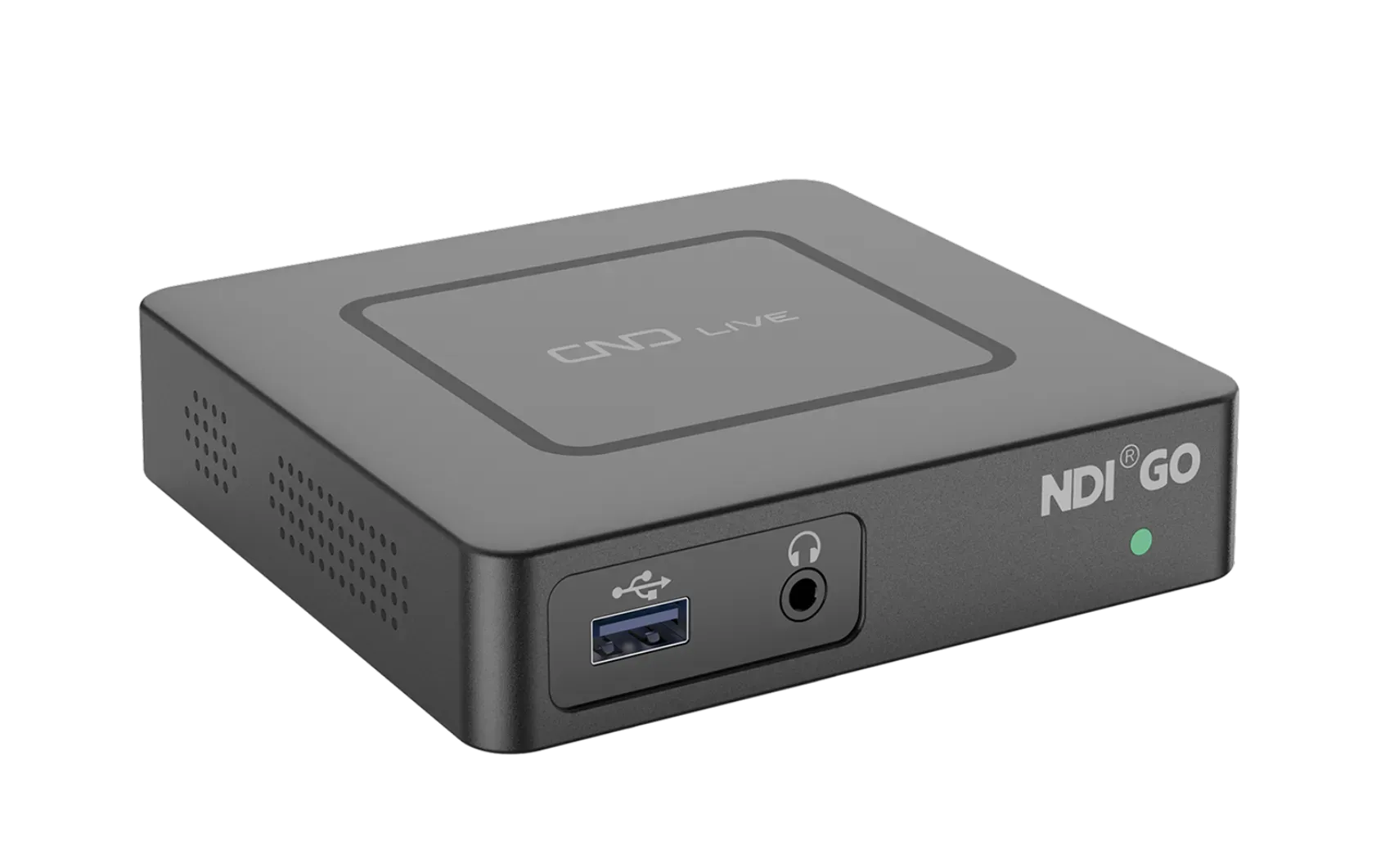
The NDI Go delivers true 4K@60Hz HDMI output, ensuring that high-resolution visuals retain their razor-sharp clarity, vibrant color accuracy, and fluid motion when projected onto massive stadium screens. Because it decodes via dedicated hardware chips rather than general software processing, it maintains sub-frame, ultra-low latency. This near-instantaneous decoding is the exact solution needed for IMAG side-screens, keeping the live close-ups of the artists perfectly synchronized with the live audio.
Built specifically for life on the road, the CNDLive NDI Go features a compact, fanless, and rugged metal chassis. The absence of moving parts means it is immune to the dust, vibrations, and heat typical of concert stages and outdoor music festivals. It can be easily tucked into a rack, zip-tied to a truss, or mounted directly behind an LED wall processor.
Understanding the complexities of live event communication, CNDLive has packed the NDI Go with essential production features. It provides native support for Power over Ethernet (PoE), allowing it to draw power directly from the network switch via the standard network cable, eliminating the need to hunt for local power outlets or run messy extension cords. Furthermore, it features integrated Tally signal processing and a 3.5mm audio interface for full-duplex voice intercom systems. This allows front-of-house video engineers and backstage crew members to stay in constant, clear communication over the very same network connection that carries the video feed.
Applying CNDLive NDI Go in a Real Production Environment
Implementing the CNDLive NDI Go within a real-world concert production environment transforms a chaotic maze of wiring into a clean, elegant, and highly efficient network topology. In a practical deployment, all video assets—including multi-angle stage cameras, wireless roaming rigs, and media servers—are converted to NDI at the source or natively output as NDI streams. These streams are then funneled into a central, high-bandwidth managed network switch located either backstage or at the front-of-house control station.
To drive the primary visual displays, CNDLive NDI Go units are deployed as localized endpoints at each physical screen destination. For the main backdrop LED wall, an NDI Go is mounted directly adjacent to the primary LED video processor. A single Cat6 cable runs from the central network switch to the NDI Go, providing both its power and the master video feed. A short, high-speed HDMI cable then connects the NDI Go output to the input of the LED processor, cleanly mapping the uncompressed 4K video across the massive display.
A similar distributed arrangement is used for the IMAG side-screens and remote venue monitors. An NDI Go unit is placed at the base of each IMAG screen tower, instantly transforming the incoming network stream into an ultra-low-latency HDMI signal for the side-projectors or independent LED controllers. For backstage dressing rooms, VIP lounges, and the director’s confidence monitors, individual NDI Go units are simply plugged into local network drops and hooked directly into standard TV displays.
Because the entire ecosystem operates on a unified network, the production’s intercom and tally systems route seamlessly alongside the video. A camera operator can plug their headset into a camera-mounted NDI device, while the stage manager plugs into an NDI Go near the stage wings, allowing them to communicate flawlessly with the main director at FOH. If the director switches focus to a specific camera, the tally data travels across the network instantly, illuminating the tally light on the camera and signaling the operator that their shot is live. This distributed processing model completely isolates the heavy lifting of video decoding to the edge of the network, protecting the central master control system from CPU overload.
Conclusion
Embracing an IP-based NDI workflow is no longer just a futuristic concept for tech-forward early adopters; it has become a vital competitive edge for modern concert organizers and live event producers. By abandoning the rigid, heavy, and costly constraints of traditional SDI and HDMI cabling in favor of a nimble network architecture, production companies can drastically slash setup times, eliminate excessive labor overhead, and unlock unparalleled creative flexibility on stage.
However, a network workflow is only as dependable as its weakest link. To guarantee the absolute stability, pristine 4K quality, and imperceptible latency required to satisfy thousands of roaring fans, dedicated hardware decoding is an absolute necessity. The CNDLive NDI Go provides the exact industrial reliability and broadcast-grade performance needed to conquer the “last mile” of live video delivery, ensuring your show goes on without a hitch.
Ready to eliminate cable clutter, optimize your crew’s workflow, and elevate the visual impact of your next tour or music festival? Visit the official CNDLive product page today to explore the full technical specifications of the NDI Go decoder and discover how to seamlessly integrate next-generation IP video production into your event ecosystem.